Find out how hybrid cars really perform at motorway speeds, including real-world mpg, engine lock-up mode, and long-distance driving explained.
Many drivers assume hybrid cars are only more efficient in the city, where stop-start traffic lets the electric motor do the heavy lifting. However, hybrid cars perform just as well on the motorway. The system does not switch off at speed. It adapts.
Do hybrid cars work well on the motorway?
Yes. Hybrid cars on the motorway operate in a different, optimised mode suited to sustained speeds. Full hybrids, such as Honda's e:HEV models, are designed to adapt rather than struggle. At motorway speeds, the petrol engine becomes the primary power source while the electric motor provides support when it is needed.
Many hybrids use a system known as engine lock-up mode. At a steady cruise, the engine connects more directly to the wheels, reducing energy losses from repeated power conversion and improving efficiency for sustained driving. This is different from city driving, where the electric motor plays a much larger role. That is not a compromise. It is the system doing exactly what it was engineered for.
What mpg can you expect from a hybrid on the motorway?
You can expect around 50 to 60mpg from a full hybrid at a steady 70mph on the motorway. That is noticeably more efficient than an equivalent petrol-only car under the same conditions.
Fuel economy does vary with speed. As speed increases, aerodynamic drag rises, which reduces the efficiency advantage a hybrid holds over a petrol car. While official WLTP combined figures provide a useful benchmark, they reflect mixed driving conditions rather than motorway-only use.
So do hybrid cars save fuel on motorway journeys? Generally, yes, especially at consistent cruising speeds. Real-world data published by the RAC and other independent motoring organisations supports the 50 to 60mpg range as a realistic expectation at a steady cruise. Your driving technique makes a difference too, and the habits that improve economy in town apply equally on the motorway.
Honda hybrid cars for motorway driving
Honda's e:HEV system combines two electric motors with a petrol engine, switching automatically between power sources depending on speed and driving conditions. There is no need to plug in. On the motorway, the petrol engine takes the lead while the electric motor stands ready to assist with acceleration or overtaking. In stop-start traffic, the balance shifts the other way.
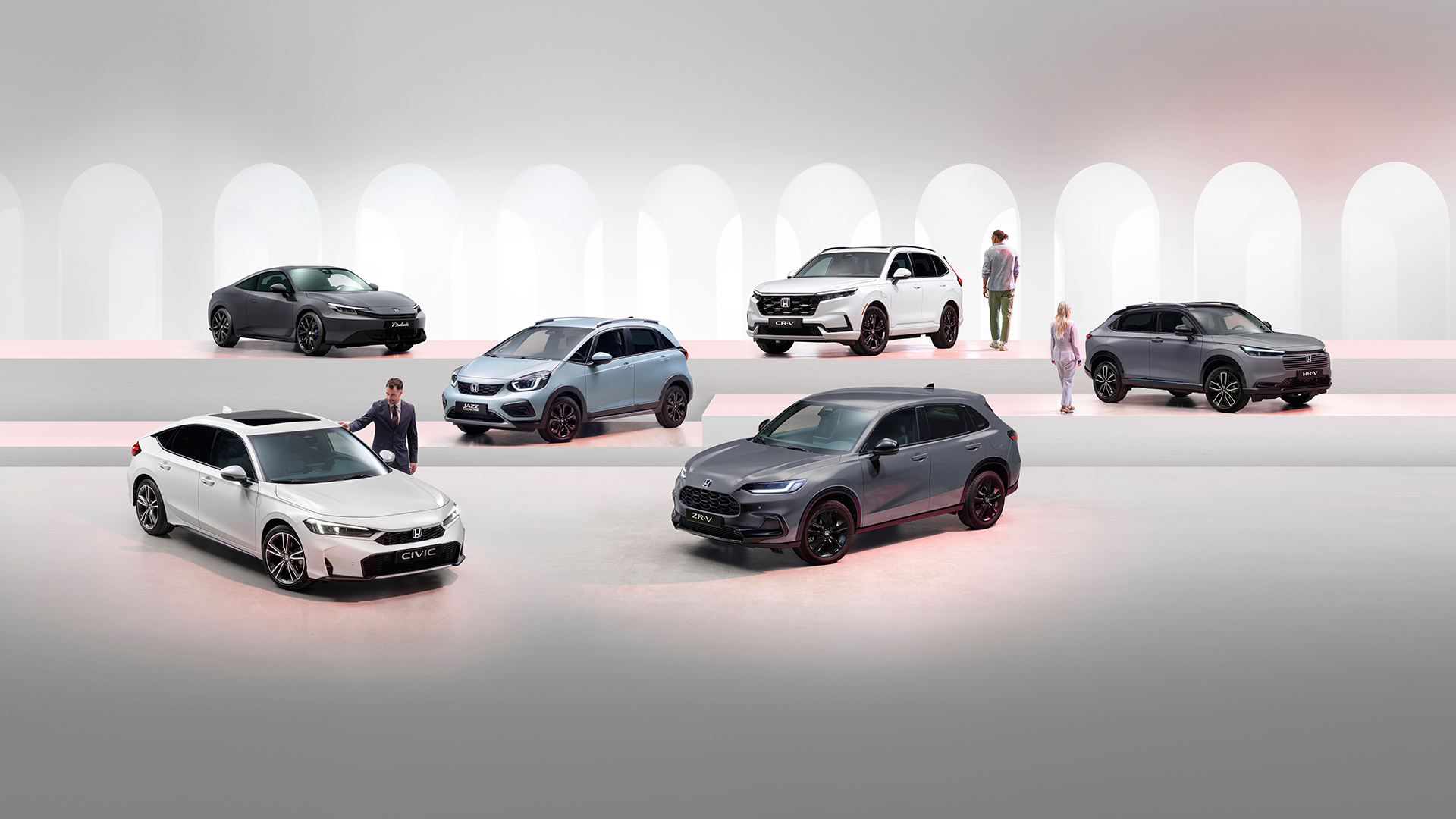
Everything switches automatically. You just drive. If you want to see what that feels like across a range of models, from compact hatchbacks to spacious SUVs, take a look at the Honda hybrid range.
How does the hybrid system behave at motorway speeds?
In a two-motor e:HEV setup, the electric motor handles most of the work at lower speeds. On the motorway, the petrol engine takes over as the primary power source, delivering consistent drive for sustained journeys, while the electric motor steps in to assist during acceleration or overtaking.
Even at motorway speeds, the system keeps recovering energy. When you lift off the accelerator on a downhill stretch or ease off approaching a junction, the car captures kinetic energy that would otherwise be lost as heat and stores it back into the battery. You do not need to think about it.
Adaptive cruise control, when fitted, supports hybrid motorway efficiency by maintaining a steady speed without the gradual drift that comes with manual throttle. Fewer speed variations mean fewer unnecessary changes between power sources, which keeps fuel use lower in the long run. The full picture of how the e:HEV system switches between its three drive modes is worth understanding if you want to get the most from the technology.
Are hybrid cars good for long-distance driving?
Yes. For hybrid car long distance driving, the practical case is straightforward. You refuel at any petrol station, just as you always have. No charge point planning, no waiting, no anxiety about whether the battery will see you to the next services. Fill up in a few minutes and carry on.
In real-world conditions, many hybrids deliver a combined range of over 500 miles on a full tank, making them well-suited to UK road trips and longer commutes. On extended motorway stretches, the electric motor contributes less, but fuel efficiency remains strong compared to petrol-only equivalents.
Honda's hybrid models are also built for reliability over high mileages, which matters on long runs. If you are a family working out which model fits your journeys, Honda's hybrid cars for families covers the range across different needs and sizes.
For anyone weighing a hybrid against a fully electric car for longer journeys, the refuelling question answers itself. A hybrid runs on petrol when the battery is low. You are never reliant on finding a charger.
FAQs
Do hybrid cars use more fuel on the motorway?
Yes, relative to city driving. The electric motor plays a smaller role at sustained higher speeds, so the petrol engine does more of the work. But real-world motorway mpg for a full hybrid is still significantly better than an equivalent petrol-only car, particularly at a steady 70mph, where engine lock-up mode keeps things efficient.
What speed is a hybrid most efficient?
Hybrids are most efficient at lower urban speeds, where the electric motor carries a greater share of the load. At motorway speeds, efficiency is still strong but the petrol engine is more active. Maintaining a steady speed rather than varying your pace is the most effective way to improve hybrid motorway efficiency on longer runs.