Learn how self‑charging hybrid cars work, using regenerative braking and intelligent petrol‑electric power to boost efficiency without plugging in. Discover the benefits for UK drivers, from smoother city driving to lower fuel costs, and see if a Honda self‑charging hybrid suits your lifestyle.
Self-charging hybrid cars have become one of the most popular choices for drivers who want better fuel efficiency without the need to plug in. Combining a petrol engine with an electric motor and battery, these vehicles manage their own energy, topping up the battery automatically as you drive, with no cables or charging points required.
Whether you’re considering your first hybrid or comparing your options across the Honda hybrid range, this article covers how the technology works, how it differs from a plug-in hybrid, and which type of driver tends to get the most from it.
What is a self-charging hybrid car?
A self-charging hybrid car combines a petrol engine with an electric motor and a small battery pack. The key distinction from a plug-in hybrid is that the battery charges itself. You never need to connect it to an external power source. Instead, it generates electricity through regenerative braking, which captures energy during deceleration that would otherwise be lost as heat.
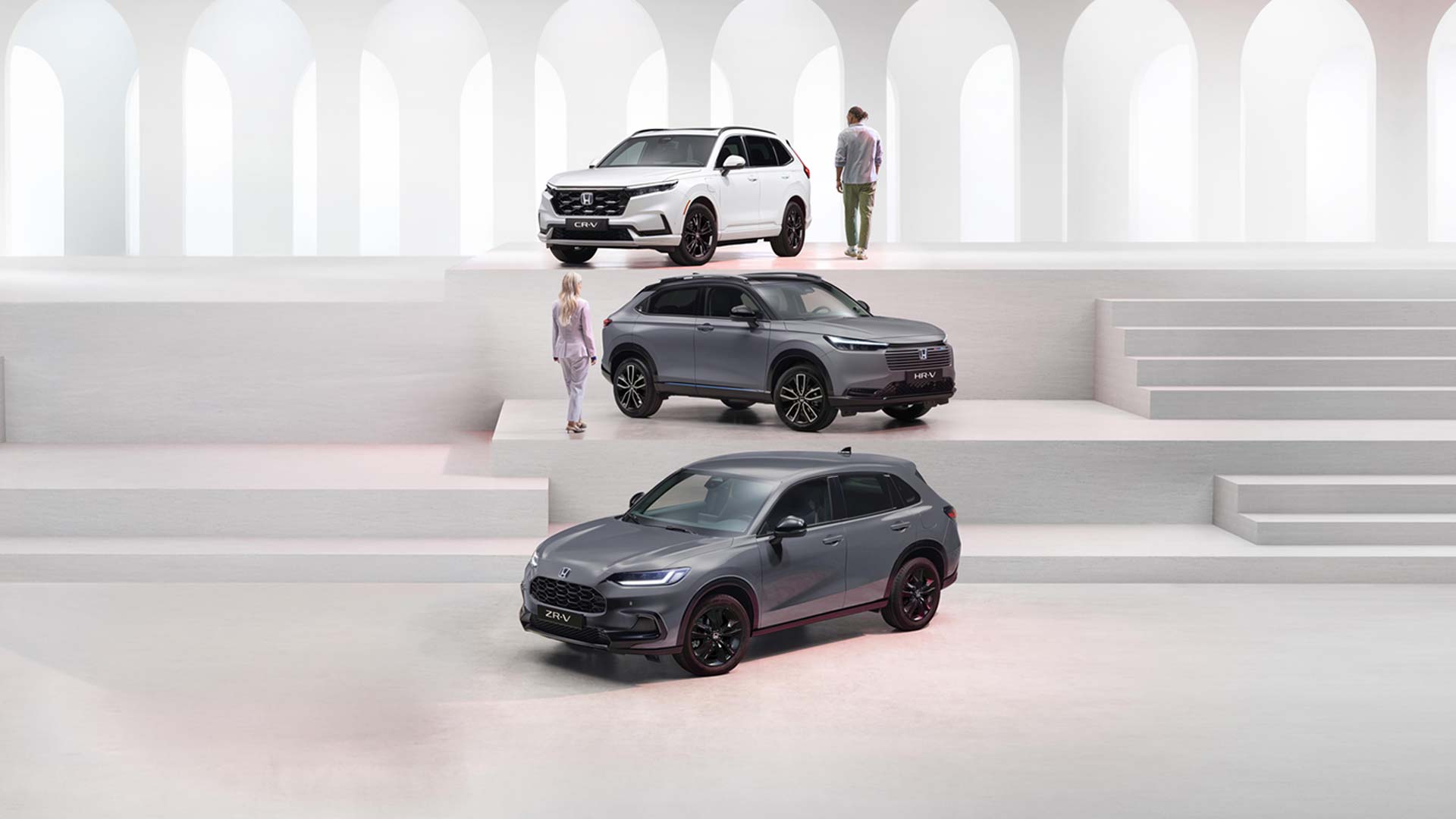
Self-charging hybrids are available across a wide range of body styles. If you’re specifically looking at a self-charging hybrid SUV, models like the Honda CR-V Hybrid and HR-V Hybrid combine the practicality of an SUV with all the efficiency benefits of Honda’s e:HEV system. For a broader look at the options, the types of hybrid cars guide is a useful starting point.
How do self-charging hybrid cars work?
Self-charging hybrid systems automatically manage the balance between petrol and electric power, switching seamlessly depending on driving conditions. The key components that make this possible are:
- Electric
- Hybrid
- Engine
When the car uses electric power
Self-charging hybrids typically draw on electric power during:
- Moving off from a stationary position
- Low-speed city driving
- Stop-start traffic
The system switches between power sources seamlessly, so you always have both available, which is particularly useful in unpredictable urban conditions.
How the petrol engine and electric motor work together
The petrol engine and electric motor operate as a team, with the system automatically deciding which source, or combination of both, is most efficient at any given moment. At lower speeds or during gentle acceleration, the electric motor typically leads. At higher speeds or under more demand, the petrol engine takes over or assists.
Honda’s e:HEV system uses three distinct drive modes: EV Drive, Hybrid Drive and Engine Drive. These optimise efficiency across different conditions. Because the car recharges itself during normal driving, there’s no need for a home charger or to factor charging time into any journey.
Regenerative braking
Every time you slow down or brake, energy that would otherwise be lost is captured and converted into electricity. The electric motor acts as a generator during deceleration, storing that charge in the battery ready for use. It’s the same principle behind regenerative braking in fully electric vehicles, applied here to keep a hybrid battery topped up without any driver input.
Self-charging hybrid vs. plug-in hybrid
The main difference between a self-charging hybrid and a plug-in hybrid (PHEV) comes down to how the battery is charged and how large it is. A self-charging hybrid generates all its own electricity through regenerative braking and the petrol engine. A plug-in hybrid has a larger battery that must be connected to an external charger to unlock its full electric range.
Plug-in hybrids can travel further on electric power alone before the engine cuts in, which can mean lower fuel costs for drivers who charge regularly at home or at work. Self-charging hybrids suit drivers who want the efficiency of electrified driving with no changes to their routine. Honda’s hybrid technology explained page covers both approaches in more depth.
Are self-charging hybrid cars worth it?
For regular commuters and city drivers, a self-charging hybrid is hard to beat. Stop-start traffic is exactly the environment where the electric motor does most of the work and fuel consumption drops most noticeably, making self-charging hybrid cars among the best choices for drivers who cover a lot of urban miles.
The best self-charging hybrid cars combine everyday ease with genuine performance and refinement. Honda’s full hybrid range spans hatchbacks, crossovers and SUVs, so there’s likely a model that fits your lifestyle.


What are the benefits of self-charging hybrid cars?
Self-charging hybrid cars offer a number of practical advantages. Electric motors are inherently quiet, and the transition between electric and petrol power happens automatically, making low-speed driving through town noticeably smoother and more refined than in a conventional petrol car.
By supplementing the petrol engine with electric power, especially in stop-start conditions, self-charging hybrids also achieve better fuel economy than equivalent conventional cars. Regenerative braking reduces wear on brake components over time too, which contributes to lower running costs. Drivers weighing up whether hybrid cars are worth it financially will typically find the savings most pronounced in urban and mixed-use driving.
FAQs
Do self-charging hybrid cars need to be plugged in?
No. Self-charging hybrid cars recharge their batteries automatically while driving, through regenerative braking and the petrol engine. There’s no need to plug in or use a charging point. The hybrid battery maintains itself as part of normal driving.
Can a self-charging hybrid run on electric power alone?
Yes, in certain situations. At low speeds, such as gentle city driving, slow-moving traffic or pulling away from a standstill, a self-charging hybrid can run purely on electric power. At higher speeds or under heavier acceleration, the petrol engine takes a more prominent role, often working alongside the electric motor.
Are self-charging hybrids good for motorway driving?
Self-charging hybrids are capable on the motorway, though sustained high-speed driving is where the petrol engine does most of the work. The electric motor still contributes during acceleration and coasting, and the system manages energy use intelligently throughout. It’s the city and suburban miles where the efficiency gains are most noticeable.
How reliable are self-charging hybrid cars?
Self-charging hybrids are generally very reliable. By sharing the workload between the petrol engine and electric motor, each component experiences less strain than in a conventional car. Regenerative braking also reduces wear on brake components over time. Honda’s hybrid cars have a strong reliability record, backed by a five-year/100,000km hybrid battery warranty across the range.