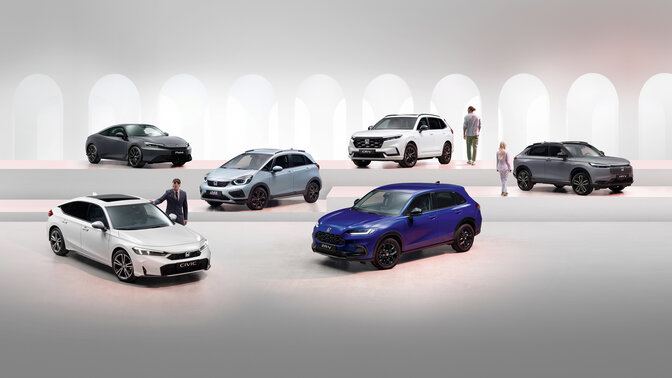
The Honda e was developed as a practical demonstration of Honda’s approach to electric vehicle design. Rather than adapting an existing model, Honda created a dedicated electric car to explore how compact size and human-centred design could work together in an urban EV. The result was a vehicle that prioritised everyday driving needs.
From the outset, the Honda e was guided by Honda’s long-standing design philosophy: Man Maximum, Machine Minimum (M/M). This principle focuses on maximising space, visibility and comfort for people, while minimising the space taken up by mechanical components. Founder Soichiro Honda conceived of the concept in the 1960s, based on his ethos not simply to make cars and motorbikes, but to improve lives.
A brief history
Honda’s approach to compact and efficient vehicles has developed over several decades, shaped by changing fuel demands, urban driving needs and evolving technology. From early kei cars and the original Civic through to later hybrid models, Honda consistently explored how smaller vehicles could be made more efficient and practical for everyday use.
In the late 1990s, this thinking led to the launch of the Honda Insight, one of the world’s first mass-produced hybrid cars. It demonstrated how electric assistance could be combined with a petrol engine to improve efficiency and reduce fuel consumption. This work laid the groundwork for Honda’s broader hybrid strategy, which continues today across much of the range.


As battery technology developed, Honda began exploring how these principles could be applied to fully electric vehicles. In 2017, the Urban EV Concept previewed this direction, signalling a move towards a purpose-built electric car rather than adapting an existing petrol model. This concept focused on compact proportions, digital interfaces and a layout designed around everyday urban use.
The production version of this idea arrived in 2020 as the Honda e. It became Honda’s first dedicated battery-electric vehicle for the European market and served as a testbed for how electric powertrains, compact packaging and digital driver displays could work together in a real-world car.
This work now feeds directly into Honda’s current and future electric strategy. Lessons learned from the Honda e can be seen in newer models and in Honda’s wider move towards dedicated electric platforms.
Design and usability
The Honda e was engineered around simplicity and daily use. Its compact proportions supported urban manoeuvrability, while its low-mounted battery contributed to balanced handling. Inside, the wide digital dashboard replaced conventional dials with a continuous display, bringing navigation, vehicle information and media into a single visual plane.
Camera-based side mirrors reduced wind resistance and improved outward visibility in tight spaces. Parking support systems and driver assistance features were integrated to reflect the car’s intended city role. These decisions were not driven by novelty but by an effort to reduce complexity for the driver and improve situational awareness.
Recognition and awards
The Honda e received several industry awards following its launch, including:
- World Urban Car of the Year 2021
- Red Dot “Best of the Best” design award
- German Car of the Year (New Energy category)
- UK awards for in-car technology and city driving
These awards reflected the car’s design execution and technical presentation rather than commercial performance.
The 2020 press release captures this excitement:

A step in Honda's EV evolution
The Honda e was not intended as a long-term volume model. Its role was to establish how Honda would approach electric vehicles from a design and usability perspective. It showed how compact size, digital technology and human-centred thinking could be combined into a workable urban EV.
In that sense, the Honda e stands as an important point in Honda’s electric journey. It provided the foundation for how later electric models are shaped and how future concepts are developed, linking Honda’s historic design philosophy with its next generation of electric vehicles.
How the Honda e shaped what came next
Although production of the Honda e has ended, its influence remains visible in Honda’s current and future electric models.
Looking further ahead, Honda has outlined its next phase of electric development through concepts and platforms that build on the same principles of space efficiency and clarity of design. The Honda Super-N is comign soon, releasing in the UK in 2026.
Super-N

Honda e FAQs
Is the Honda e still on sale in the UK?
No. The Honda e has been discontinued in Europe and is no longer available for new purchase. That said, limited stock and second-hand cars may be available for purchase.
What made the Honda e stand out from other small EVs?
The Honda e’s charm lay in bold details: retro-future styling, a tight rear-wheel-drive footprint, a dual-screen digital cockpit, and camera-based side mirrors. Touchpoints that elevated it beyond the typical city-EV.
What is the correct way to style the Honda e name?
Official Honda usage always renders it as Honda e, with a space before a lowercase “e”. A simple but deliberate shorthand that became as much a style cue as the car itself.