


A well-kept lawn takes time. Through spring and summer, especially, that means regular mowing, often more than once a week. A robotic lawn mower takes that task off your hands entirely, working to a schedule you set while you get on with something else.
If you have been curious about how robotic lawn mowers actually work, or whether one could suit your garden, this article walks through the key technology behind them, from how they find their way around your lawn to how they cut, charge, and keep themselves on schedule.
What is a robotic lawn mower?
A robotic lawn mower is a battery-powered, autonomous machine that cuts your grass automatically within a defined area of your garden. Unlike a push mower or ride-on, it does not need you to operate it. Once it is set up, it navigates your lawn independently, trims the grass regularly, and returns to its charging station when the battery runs low, all without you needing to get involved.
The result is a lawn that is mowed little and often, which suits the grass much better than the occasional heavy cut. Because robotic mowers work frequently and remove only the top few millimetres of growth each time, the lawn stays in consistently good condition throughout the growing season.
Honda has been developing robotic mowers for over a decade. The Miimo range covers lawns from 400m² up to 4,000m², with models suited to everything from compact urban gardens to large, complex outdoor spaces.
How do robotic lawn mowers navigate?
Navigation is what makes a robotic mower genuinely autonomous. It is how the mower knows where it is, where it has been, and where the boundaries of your lawn are. Without a reliable navigation system, a robotic mower would simply wander off course or miss sections of grass.
Boundary wires
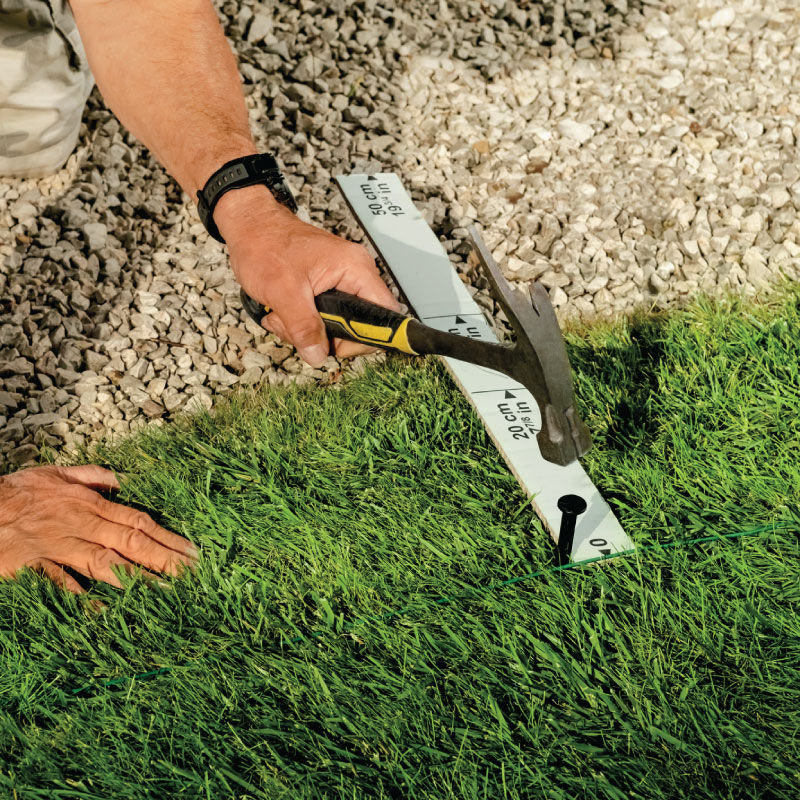
Most robotic mowers use a boundary wire to define the mowing area. This is a low-voltage cable laid around the perimeter of your lawn, either pegged to the surface or buried just beneath it. The wire emits a signal that the mower detects, telling it when it has reached the edge of its designated zone and needs to turn back.
The boundary wire also helps the mower navigate around obstacles within the lawn. By creating a loop around a tree or flower bed, for example, you can teach the mower to avoid that area. Setting the boundary wire up correctly is one of the most important steps in getting a robotic mower working well, and it is worth taking time over the initial installation. Boundary wires are a dependable way to ensure your robotic lawnmower stays within the right parameters, offering precise, reliable boundary definition, without any of the connectivity issues that can happen with models using GPS instead. GPS signals can be disrupted by tall buildings, tree cover, or even cloud cover. Boundary wires offers consistent performance and are especially advantageous in smaller gardens or complex spaces.
Sensors
All robotic mowers rely on sensors to operate safely. Bump sensors around the body detect contact with an obstacle and trigger the mower to stop, reverse slightly, and change direction. Lift sensors detect when the mower is picked up or tilted, and immediately stop the blades as a safety measure. On the Miimo HRM 1000-4000 models, rapid-reaction bump sensors respond instantly to contact, protecting both the mower and anything it encounters.
How the cutting system works
Robotic mowers cut differently from conventional mowers. Rather than a single wide blade making a heavy pass, they use a small rotating disc carrying two or three razor-sharp blades. These trim only the very top of the grass on each pass, removing just a few millimetres at a time.
Because the mower cuts so frequently and removes so little each time, the clippings are tiny. There is no need for a grass collection bag. The fine particles fall back into the lawn and decompose quickly, returning moisture and nutrients to the soil. Over time, this micro-mulching effect contributes to a healthier, greener lawn without any additional effort on your part.
Cutting height is adjustable on all Miimo models, ranging from 20mm to 60mm, so you can set the finish to suit your preference and the time of year. The HRM 4000 Live takes this further with automatic cutting height adjustment, which adapts based on how quickly the grass is growing. On models with the Mii-Monitor app, you can also adjust cutting height remotely without going out to the mower.

How charging and scheduling work
The charging station is the mower's home base. It is a small unit placed at the edge of the lawn and connected to a power supply. When the mower's battery drops below a certain level, it navigates back to the station, docks automatically, and recharges itself. Once charged, it picks up from where it left off or follows its next scheduled session.
Most Miimo models charge to full in around 40 to 60 minutes, which means the mower can complete multiple mowing sessions throughout the day. For most gardens, running three to five sessions per week during the growing season keeps the lawn consistently neat. A robotic mower works best when the rest of your spring lawn care routine is in good shape, too. Things like aerating, scarifying, and a first seasonal feed all help the grass respond well to regular cutting.
Scheduling is set when you first configure the mower, and most models allow you to adjust this at any time. Miimo models with Bluetooth connectivity can be managed through the Mii-Monitor app, letting you change schedules, check the mower's status, or send it out to mow from your phone. Live models with mobile connectivity give you full control from anywhere, and also support Amazon Alexa voice commands. Smart timers on selected models can adapt automatically, pausing during heavy rain and resuming when conditions improve.
Is a robotic lawn mower right for your garden?
Robotic mowers work best on lawns that are regularly maintained and have a reasonably clear layout. If your garden is relatively open, with a defined perimeter and no severe slopes, a robotic mower will very likely handle it well. They suit busy households particularly well. If you are still deciding what type of mower fits your garden, Honda's petrol and cordless mower range covers the alternatives worth comparing.
Gardens with very steep banks, heavily obstructed layouts, or areas where the lawn is divided into sections with no connected path between them can be more challenging. Very narrow passages, depending on the model, may also be a limiting factor. Slopes and uneven gardens have their own specific considerations when it comes to robotic mowers.
It is also worth remembering that robotic mowers are designed for regular maintenance of established lawns, not for tackling long, overgrown grass. If your lawn needs a significant cut to bring it back to a manageable length, it is worth doing that first before introducing a robotic mower.
Frequently asked questions
How does a robotic lawn mower know where to go?
It uses a combination of a boundary wire that defines the mowing area and onboard sensors that detect obstacles and edges. Newer models also use satellite-assisted navigation to plot more efficient routes. The mower works within those boundaries automatically, covering the lawn systematically over time.
Do robotic lawn mowers collect grass clippings?
No. Robotic mowers cut little and often, removing only a few millimetres of growth at a time. The clippings are so fine that they fall back into the lawn and break down naturally, acting as a light fertiliser and improving soil health over time.
How often does a robotic lawn mower need to charge?
The mower returns to its charging station automatically whenever the battery runs low. Most Miimo models recharge in around 40 to 60 minutes and are designed to complete multiple sessions per day. You do not need to manage this manually.
Can a robotic lawn mower work in the rain?
Yes, most robotic mowers, including the Miimo, are weatherproof and can mow in light rain. Models with smart timers will pause during heavy downpours and resume automatically once conditions improve, so your mowing schedule stays on track without any input from you.
What are the limitations of a robotic lawn mower?
Initial setup, including boundary wire installation, takes some time to do properly. Robotic mowers are also less suited to very steep or heavily obstructed gardens, and they are designed for regular maintenance of established lawns rather than cutting long or overgrown grass. Like any mower, proper seasonal care and storage keeps the machine in good working order and extends its life.
The Honda Miimo range covers lawns from 400m² up to 4,000m². If you know your garden size and layout, the Miimo comparison tool makes it easy to match the right model to your needs.