


If your garden has a slope, a few bumps, or a layout that feels a bit tricky, you might assume a robotic lawn mower is not for you. It is a common concern, and a reasonable one. But modern robotic mowers have come a long way, and many gardens that look challenging at first glance are well within what a capable model can handle.
The honest answer is that performance depends on the model, the terrain, and how you set things up. This article walks through what actually matters when using a robotic mower on slopes and uneven ground, so you can make a confident decision about whether one suits your garden.
Can robotic lawn mowers handle slopes?
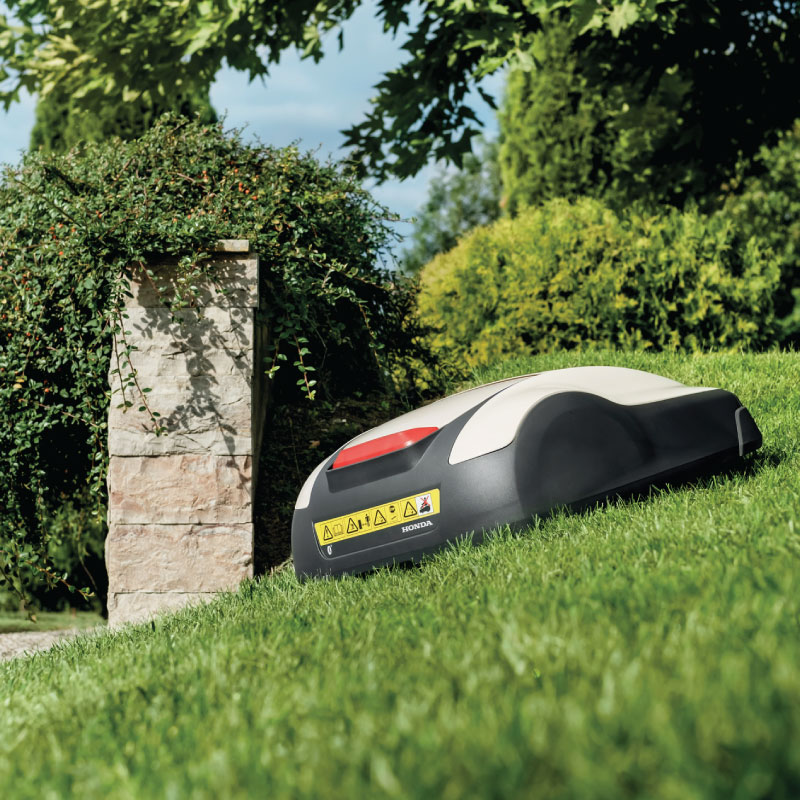
Yes. Most modern robotic mowers are built to cope with slopes, and many handle them well. The key variable is the maximum incline rating, which tells you the steepest gradient a model is designed for. This is always worth checking before you buy, and it should match or comfortably exceed the steepest part of your garden.
Across the Honda Miimo range, for example, the HRM 1000, 1500, 2500 and 4000 models are all rated to handle slopes of up to 47%, equivalent to a 25-degree incline. That covers a wide range of sloped gardens, from gently rolling lawns to more pronounced banks. Smaller models like the Miimo 40 and 70 are rated up to 27%, which is still more than enough for a typical garden with a moderate slope.
That said, the slope rating alone is not the whole story. How a mower performs turning across a slope, mowing near edges, or moving on wet grass can all be more demanding than straight-line climbing. Treat the rated figure as a solid guide, but also think about those more varied movements when choosing a model.
What about uneven ground?
Slopes are one thing, but many gardens also have subtler challenges. Small dips, raised roots, patches of softer ground, or surfaces that change from firm to boggy depending on the time of year, all affect a robotic mower in slightly different ways.
On uneven ground, the main concerns are keeping the mower balanced and maintaining enough wheel contact for it to continue moving. If a mower tips or loses grip, it can miss areas, stall, or simply stop. This is why suspension-style wheel systems and intelligent lift sensors matter. Miimo models, for instance, include rapid-reaction lift sensors that detect when the mower is on unstable ground or gets stuck, and respond immediately to prevent it from getting wedged in a dip or hollow.
The mild unevenness found in most established gardens is generally something a capable robotic mower handles without issue. If the ground is more severely rutted or has significant changes in level over short distances, it is worth being realistic about what even a well-specified mower can do.

How traction and wheel design make a difference
Traction is what keeps a robotic mower moving on a slope rather than sliding, and it comes down to several design factors working together. Wheel tread is one of the most important. Deeper, wider treads push through wet or soft grass rather than skating over the surface. The Miimo HRM 1000-4000 models use broad-tread rear wheels that are specifically designed to shed mud and maintain grip in wet conditions. This is important in UK gardens, where morning dew and rain are a routine part of the growing season.
The drive system also plays a role. How the mower distributes power to its wheels affects how it behaves on a camber or mid-slope. Weight balance matters too. A mower that is too light at the rear is more likely to slip, while good weight distribution across all four wheels helps maintain contact on uneven surfaces.
It is also worth remembering that wet grass reduces grip for any mower, regardless of its incline rating. If your garden has a slope, try to avoid scheduling mowing sessions in wet conditions where possible, especially early in the morning when dew can make surfaces significantly more slippery.
How navigation helps on complex layouts
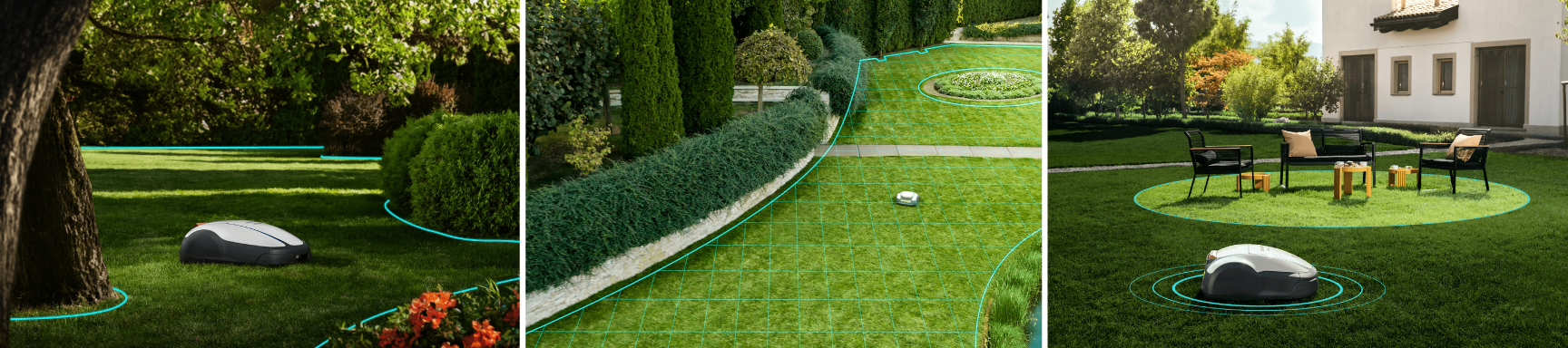
Understanding how robotic lawn mowers work on more complex gardens requires looking beyond the wheels. Navigation is what allows a mower to cover the whole lawn efficiently, avoid obstacles, and adapt to gardens that are not a simple rectangle.
Most robotic mowers use a combination of a physical boundary wire and onboard sensors. The boundary wire defines the mowing area; the sensors help the mower detect and respond to objects within it. On complex layouts with narrow passages, multiple zones, or irregular shapes, this combination becomes particularly important.
Why setup matters as much as the mower itself
Even a well-specified mower will underperform on challenging terrain if it has not been set up correctly. The installation decisions you make before the first cut have a real impact on day-to-day performance.
A few things are particularly important on challenging terrain. Where you position the docking station matters. Flat, stable ground is preferable, and the mower should be able to reach it reliably from every part of the lawn. Boundary wire layout also matters; running the wire on flat ground before the slope, rather than at the top or bottom of a bank, helps the mower navigate the transition more smoothly.
It is also worth being selective about which areas of the garden you include in the mowing zone. If there are sections that are very steep, heavily rutted, or have fixed obstacles like trees and furniture on an incline, you may get better results by excluding those areas and tending to them separately. The Honda Miimo setup guide covers the installation process in detail and is a useful reference for getting things right from the start.
Robotic lawn mowers for large gardens
For robotic lawn mowers in large gardens, coverage capacity is the first thing to check. Models are typically rated by the maximum lawn area they can manage in a given period, and going over that limit means the mower will not complete the job in a reasonable time, regardless of how capable it is on slopes.
The Miimo HRM 1000-4000 range covers lawns from 1,000m² up to 4,000m², and multiple Miimo units can be paired together through the Multi-Miimo system for even larger spaces such as commercial grounds. For large gardens that also have complex layouts, with narrow sections, multiple levels, or zones separated by paths, the satellite-assisted navigation and shortcut wire features become increasingly valuable.
When a robotic mower may not be the right fit
Robotic mowers handle more than most people expect, but there are situations where they are not the best tool for the job. Very steep banks, beyond the rated incline of whichever model you are considering, are an obvious example. So are gardens with heavily rutted ground, areas of very rough or stony terrain, or spaces where the lawn is divided into sections with no connected route between them.
Very narrow passages below around 60-75cm wide can also be a limiting factor, depending on the model. And if your lawn is significantly overgrown, it is worth cutting it down to a manageable height before introducing a robotic mower, as most are optimised for regular maintenance rather than heavy cutting sessions.
If you are unsure, it is worth being honest with yourself about the most demanding parts of your garden and checking those sections against the specifications of any model you are considering. The Miimo specifications page has the detailed figures for each model side by side, which makes it easier to compare.
Frequently asked questions
Can a robotic lawn mower mow on a slope?
Yes, many can. Maximum incline varies by model, so always check the slope rating in the specifications before buying.
Do robotic lawn mowers work on uneven ground?
Many do, particularly on mildly uneven lawns. Performance depends on wheel grip, drive system, and how rough the ground is.
What slope can robotic lawn mowers handle?
It varies by model. The Miimo HRM 1000, 1500, 2500 and 4000 handle slopes up to 47% (25 degrees), while the Miimo 40 and 70 handle up to 27%. Always check the specification for any model you are considering.
Are robotic lawn mowers suitable for large gardens?
Yes, with the right model. Check the coverage capacity in the specifications, and consider the garden's shape and complexity alongside the size.
Does the setup need to change for a sloped garden?
In many cases, yes. Docking position, boundary wire layout, and which areas to include all affect performance. Getting set up right from the start makes a real difference.