

Are robot lawn mowers worth it?

For many homeowners, yes. Robotic lawn mowers are worth it if you want to spend less time mowing through the growing season and still have a consistently tidy lawn. They work automatically on a schedule, cut little and often, and return to charge themselves without any input from you. The main trade-off is a higher upfront cost than a conventional mower, and they are not the right fit for every garden.
Whether one is worth it for you depends on your lawn, your lifestyle, and how much you value the time it saves. Here is what you need to know before deciding.
What are the benefits of a robotic lawn mower?
The case for a robotic mower comes down to a few practical advantages that stack up over a full growing season:
- Time saving. The mower works on an automatic schedule, cutting the lawn in the background while you do something else. Across spring and summer, that replaces hours of weekly mowing.
- Consistent lawn quality. Cutting little and often keeps grass at a more even height throughout the season, without the cycles of growth and hard cutting that come with weekly manual mowing. The Honda Miimo's twin-blade disc system produces particularly fine clippings that fall back into the lawn and break down naturally, feeding the soil as they decompose.
- Quieter operation. Robotic mowers run far more quietly than petrol models, making it practical to schedule mowing in the early morning or evening without disturbing anyone.
- Lower running costs. There are no fuel costs. Electricity use for charging is modest, and the main ongoing expense is periodic blade replacement.
- Less physical effort. Once set up, the mower handles routine cutting entirely on its own, which is particularly valuable for larger lawns or for homeowners who find regular mowing physically demanding.
Are robotic lawn mowers expensive to run?
The upfront cost is higher than most conventional mowers. The Miimo HRM 1000-4000 range starts from around £929. Smaller gardens are well served by the Miimo 40 and 70, which start at a lower price point.
Day-to-day running is relatively affordable. There are no fuel costs, electricity use is low, and the main ongoing expense is blade replacement. Like any garden equipment, proper seasonal maintenance extends the mower's working life considerably – booking an annual cost-effective servicing with your local Authorised Dealership helps ensure the integrity of your robotic lawnmower for longer, with blade replacements and software updates included as standard.
Whether the cost is worth it is less a numbers question and more a question of how much you value the time and effort it saves. Homeowners who mow regularly across a long growing season tend to find the case for a robotic mower strengthens the longer they own one.
What should you consider before buying a robotic lawn mower?
Robotic mowers are not the right fit for every garden. Before buying, it is worth working through these factors:
- Lawn size and shape. Models are rated by maximum mowing area, so matching the mower to your garden is important. Separate lawn sections, narrow passages, or complex layouts add complication. Slopes and uneven ground have their own requirements depending on the model.
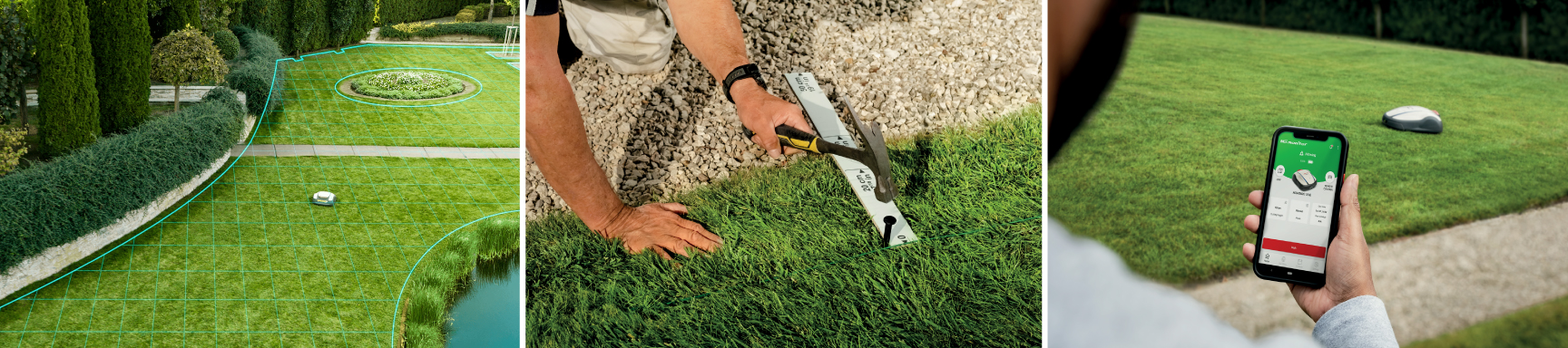
- Setup time. Installing the wire is a straightforward process – simply lay it around the edges of the lawn, starting at the docking station, then either peg it down and let grass growth cover it, or use an edging tool to bury it slightly. The Miimo setup guide covers how to get started.
- Lawn condition. Robotic mowers are designed for regular maintenance of established lawns, not for tackling long or overgrown grass. If your lawn needs bringing back to a manageable state first, that is worth doing before introducing a robotic mower.
- Edge work. Most gardens still need some manual attention along borders or paths that the mower cannot reach. A robotic mower reduces mowing, but it does not eliminate every element of lawn care.
Can a robotic lawn mower replace a traditional mower?
For many gardens, largely yes. The frequent cutting schedule means the grass doesn’t get long enough to need a heavier cut, and routine mowing is something the machine handles on its own. Some homeowners keep a lawn trimmer for tidying the edges manually, or a conventional mower for the occasional jobs that the robotic mower isn’t set to cover, but for week-to-week maintenance, it can take over the majority of the work.
If you are still deciding which type of mower suits your garden, comparing Honda's petrol, cordless and robotic range is a useful starting point, and what to know before you mow covers the broader buying considerations across all types.
Are robotic lawn mowers worth it?
For busy homeowners with a reasonably straightforward garden, a robotic mower is genuinely worth it. The time saving is real, the lawn quality tends to improve through consistent cutting, and the day-to-day running is low effort. The upfront investment is higher than that of a conventional mower, but for anyone who mows regularly across a full season, the case tends to become clearer the longer they own one. The key is choosing a model that matches your garden rather than expecting any robotic mower to work in any space.
Not all robotic mowers are created equal. Many struggle with complex garden layouts, steep slopes, or narrow passages.
Miimo is different. Designed to handle intricate gardens with ease, it navigates around flower beds, ponds, and edges with precision. Using Honda’s advanced boundary guidance, it intelligently adapts to different terrains. Its optimised centre of gravity, combined with strong traction and grip, allows it to tackle slopes of up to 25° (47%) with confidence.
Even in tighter spaces, Miimo performs effortlessly, navigating passages as narrow as 60 cm wire-to-wire.
The Honda Miimo range covers lawns from 400m² up to 4,000m². The Honda Lawn and Garden blog has further practical reading if you want to explore before deciding.