

What Type of Generator Do I Need for Commercial Use
Need a commercial generator but unsure where to begin? Explore your options and find help on how to decide with our in-depth guide to Honda generators.

For many businesses, generators allow them to operate effectively. Providing a source of power regardless of location, commercial generators are a reliable means of carrying out site work. For many businesses, they’re also a means of backup power, should primary systems fail.
Choosing the right generator for commercial use can be a minefield. There are multiple factors to think about, whether it’s the types of generators, size, or power output. If you’re unsure about what you need, or even where to begin, we’ve put together a guide to help you find the right generator for you.
Start by defining your business power requirements
Before jumping into the world of Honda generators and the products on offer, it can be helpful to think about your needs as a business. How much power do you need, how often will you need it and do you have any specific requirements?
Businesses that need generators for industrial tools on building sites will have different requirements from event organisers who need to keep the lights on at a wedding. If your work sees you working both inside and out, or if you’re required to travel, you may need an amount of adaptability in your generator. Think about the conditions your generator might face. Will it spend most of its time indoors, or will it be left outside in all weathers?
If you need a generator to serve as a backup source of power, you’ll need to consider the output required and factor that into your buying decisions.
Types of generators suitable for commercial use
While all generators do the same basic task, providing power, different types of generators are better suited to different tasks. Below, we’ll explore a selection of generators based on their type and the commercial work they’re best suited to.
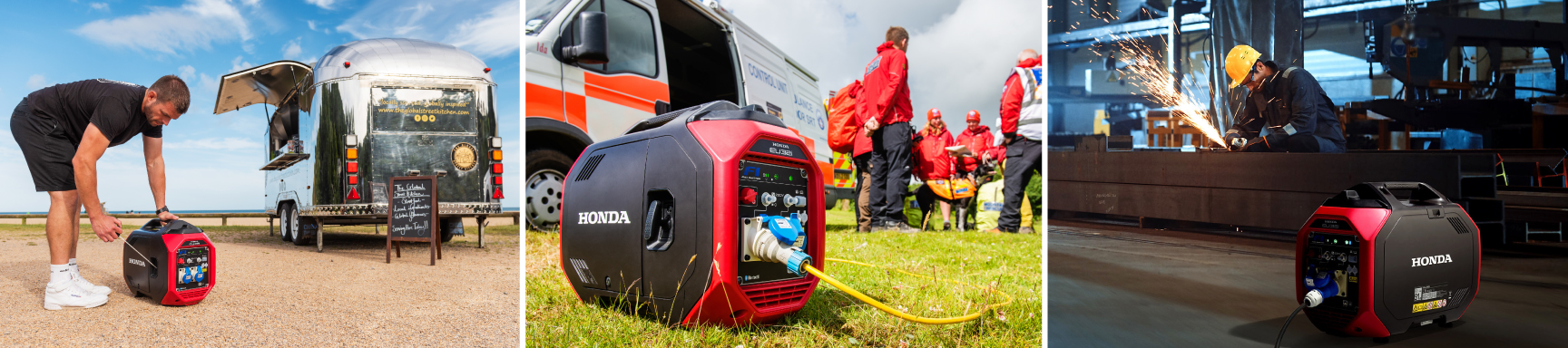
Inverter generators
Inverter generators are a quieter, cleaner option when compared to traditional generators - they’re often more fuel-efficient, too. With stable outputs, they’re commonly used to power sensitive electrical equipment, such as computers or lighting, because they’re unlikely to damage systems. Inverter generators are commonly used on mobile sites like food trucks, event trailers, and film sets. They can also be used for indoor tasks like powering equipment for small site offices, facilities maintenance, HVAC servicing points, and temporary lighting setups.
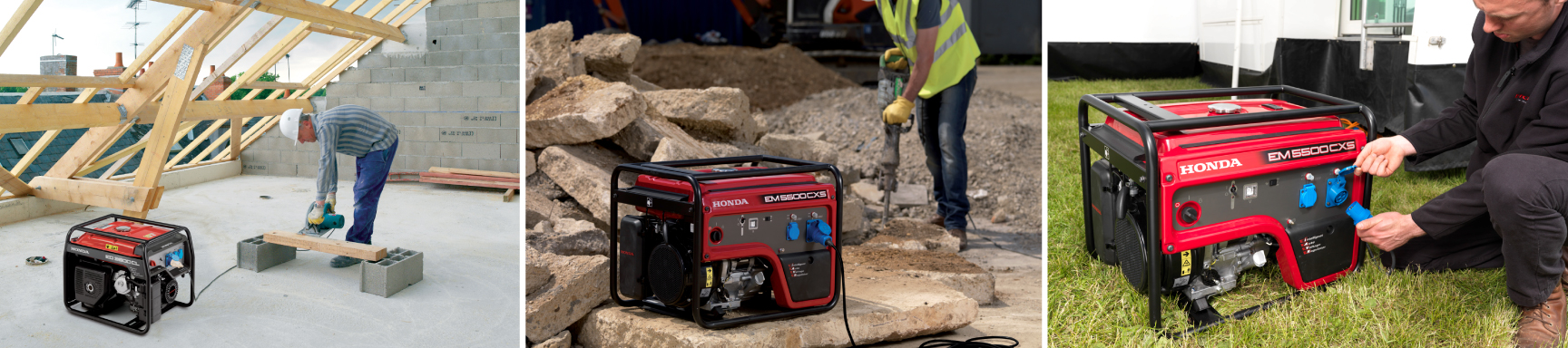
Specialist open-frame generators
Specialist open-frame generators are designed for heavy-duty jobs in a range of conditions. They’re found on commercial jobs where a large output is needed, and in locations where conditions aren’t always ideal. Often surrounded by a durable steel frame, these commercial-grade engines can be found on building sites, in workshops and on farms. As a reliable source of power, open-frame generators offer a practical solution for businesses that require a dependable output.
Standby / fixed installation generators (large scale)
If you need a large source of power or need to maintain continuous operations, you may require a fixed generator. That is, one which is professionally installed, potentially permanently, or semi-permanently. They may also be diesel-powered and come with transfer switches or ATS. Fixed or standby generators are a level above inverter and open-frame generators, but should be considered if your power needs are especially large or critical to operations.
How to size a commercial generator correctly
When deciding which commercial generator is best suited to your operational needs, you’ll need to accurately size up your requirements. You must be able to do this, as too little or too much power can have a significant impact. An oversized generator will waste money and fuel, while an undersized generator can result in overload.
Below, we’ll go through the process of sizing your commercial generator in detail.
Understand running vs starting (surge) power
First, you’ll need to understand the difference between running vs starting power. Some business equipment will draw on extra power when it’s started up, including motors, compressors and pumps. Because of this, you’ll need to factor in the power needs of starting your equipment, not just running it.
Consider single-phase vs three-phase, and power factor (kW vs kVA)
You’ll also need to decide whether single-phase or three-phase is best for you, and consider the power factor. Businesses that require a small output, on things such as simple tools, could get by on a single-phase generator. However, if you require more power, three-phase circuits may be necessary. Three-phase power can deliver more and is more efficient, making it a useful alternative for many businesses.
You may also need to think about the power factor of your generator. This involves the kilovolt-ampere, or kVA, which is the apparent power, or the total that a generator can produce. The actual power, kilowatts (kW), is the power that is converted into a useful output.
Use load-calculation examples:
- Start by making a list of all the equipment that the generator will need to power.
- Then find the wattage of each item.
- You’ll need both the running and starting watts.
- Tot up the total running watts and the max starting wattage. Combine both for the total required wattage.
- Add a safety margin of 20-30% and convert the figure to kVA.
If you needed a generator for a building site, you might need to power:
- A circular saw (1,600 running watts & 0 starting watts)
- A set of work lights (500 running watts & 0 starting watts)
- An air compressor (2,000 running watts & 4,000 starting watts)
The total would be 4,100 running watts, and the highest starting watts would be 4,000. Combined, the total required watts would be 8,100 watts or 8.1kW.
To add a safety margin of 25% we would times the total required watts (8.1 kW) by 1.25 = 10.125 kW. To convert this to kVA, you need to use the industry standard power factor of 0.8. So, 10.125/0.8 for 12.65 kVA.
A building site with these requirements would need a generator rated for at least 12.65 kVA to run all the equipment.
Calculating the needs for a burger van would look something like this:
- Fryer: 3,000 W, 0 starting watts
- Fridge: 500 W, 1,500 starting watts
- Coffee machine: 1,200 W, 0 starting watts
- Interior lights: 100 W, 0 starting watts
- Extractor fan: 400 W, 800 starting watts
Total watts: 5,200 W (5.2 kW) + Highest starting watts: 1,500 W = 6,700 W (6.7 kW)
Add safety margin: 6,700 W * 1.25 = 8.375 kW
Convert to kVA: 8.375/0.8 = 10.47 kVA
You would need a generator that provides roughly 8 kW or 10.5 kVA for your burger van.
Key factors businesses should consider when picking a generator
Even knowing how much power you need, you’ll still have plenty of options to choose from. To narrow it down, you should think about the following factors:
Noise & acoustic impact
Generators, depending on the type, can make a lot of noise. If you need to use a generator in a shared space, in public, or have neighbours that are sensitive to sound, you’ll need to consider the acoustic impact. Noise laws and regulations might also dictate your decisions.
Fuel type, runtime and refuelling logistics
Generators run on a variety of fuels, but the fuel used often depends on the type of generator and its purpose. Diesel generators are typically more rugged, whereas petrol generators are typically lighter. Liquid petroleum gas and propane generators produce fewer emissions, and the fuel can be stored indefinitely. For large, permanent installations, natural gas is typically used.
You’ll need to consider your expected usage and choose a generator that matches your runtime needs.
Output quality and sensitive equipment compatibility
If you’re powering sensitive electronic devices, such as computers or measuring equipment or networking tools, you’ll need to think about the output quality of your generator. For most devices, an inverter or regulated output is preferred.
Portability, installation, and maintenance access
Will your commercial activity require a portable generator? If you need to travel with your generator, think about its portability and the logistics of travelling with it.
Similarly, does it need to be simple to install in a new location, and is it easy to access for general maintenance?
Safety, compliance and controls
As a piece of equipment, your generator will need to meet local regulations. This might include noise limits, building regulations, and safety measures. Think about the exhaust placement and the ventilation required to operate your generator safely. Are there any other safety measures, specified controls or permits that your generator will need as per government regulation?
When a Honda generator fits your commercial needs
At Honda, we offer commercial-grade generators designed for use in a variety of applications, from sensitive electronic work to heavy-duty construction and even as a source of back-up power for the home.
Our Specialist Open Frame series provides reliable commercial-grade GX engines for a range of jobs. Well-suited to the outdoors, heavy use and demanding outputs, these commercial generators deliver a regulated output and can run for up to 12 hours. If you don’t require something as robust or heavy-duty as an open frame generator, a Honda inverter may be a better option. Compact and lightweight, these small but mighty engines are ideal for small offices, caravans and general electronics.
If you already have an idea of your generator needs, you can check them against our specification pages to find a model that fits the brief.
Operational, maintenance and safety guidance for commercial users
Generators, like all tools, may need some maintenance from time to time. Proper upkeep and safe use can reduce the chances of wear and tear, something you should consider if your generator will be essential to your business.
Things to consider include:
- Ensure your generator is suited to the environment you use it in, and that the storage location is also suitable.
- Check the exhaust and any ventilation works as it should.
- Regularly check the oil and fuel levels of your generator, and refuel safely.
- Avoid overload by limiting the electronics you hook up to your generator.
Regularly testing your generator can be a great way to identify issues early on and confirm that everything is working as it should be.
FAQs
Do I need three-phase power for my business generator?
The need for three-phase power will depend entirely on your needs. Three-phase power is needed for tools or equipment that soak up a lot of power, such as heavy machinery. Work out your power needs, and if you need more than 20-25 kVA, three-phase power is probably necessary.
How much extra capacity should I allow when sizing a generator for a workshop?
As a general rule, it’s best to add an extra 25% to your power needs when deciding on a generator. If you’re concerned that you may need more power for your workshop, think carefully about your requirements and recalculate appropriately.
Can I safely run IT equipment and computer servers on a standard open-frame generator?
While you can run IT equipment and servers on a standard open-frame generator, it’s generally inadvisable. There can be voltage fluctuations that can impact sensitive equipment, and the electrical waveform generated by open-frame generators can damage servers.
What maintenance schedule does a business-grade generator need?
A general service is recommended every 3, 6 and 12 months, or every 50, 100 and 300 hours of operation – whichever happens sooner. Some tasks, such as checking the oil levels, need to be checked more often, while in-depth servicing can be carried out annually.
Is a portable generator practical for regular site use or is a fixed standby better?
The right solution will depend on the specifics of your site and the work that’s carried out. Fixed generators offer much greater reliability and can sustain high-power outputs, but if there’s any need for flexibility in the future, a portable generator would be best.