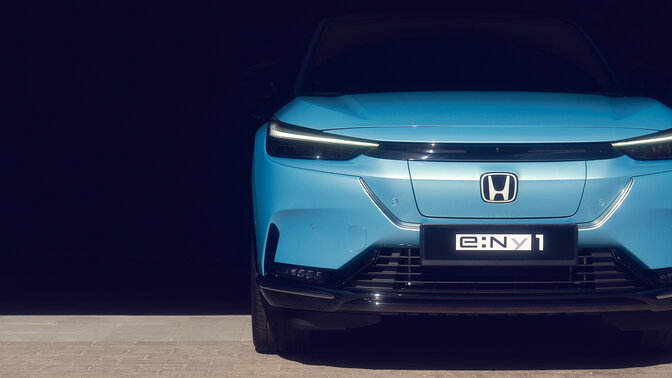
Driving through Europe in your EV may feel a little daunting if you’ve not done it before, but with this handy guide you’ll soon be planning your first European road trip and saying au revoir to the UK!
Does Europe have EV charging points?
Yes! Just like in the UK, Europe has a wide array of public charging points. From dedicated roadside charging stations to supermarkets, car parks and tourist attractions, you can find places to charge your Honda EV, much as you would at home. All the big hotel chains such as Marriott and Hilton have charging stations for guests, as do popular campsites such as Eurocamp, which has over 100 destinations with EV hook ups.
Whilst searching for accommodation using a hotel comparison website, such as TriVaGo or hotels.com, you can filter your results by ‘EV charging’, making it even easier to plan your road trip.

Which countries have the most EV chargers?
The Netherlands and Germany have by far the highest number of EV chargers in Europe currently, each with over with 200,000. France, Belgium and Italy are next according to the December 2025 figures published by the European Alternative Fuels Observatory, whilst Malta only has just over 100.
Netherlands
202,833 chargers.
Germany
200,830 chargers.
France
186,717 chargers.
Belgium
98,707 chargers.
Italy
70,039 chargers.
Do the charging cables differ in Europe?
No, European chargers use the same type 2 connectors that we use in the UK for AC charging, whist the rapid DC chargers have tethered cables with a CCS connector like we have, meaning you don’t need any special adapters to charge your EV in Europe.

Plan ahead
To avoid any unnecessary stress, plan your journey using a dedicated EV charging map or app. These often allow you to filter by payment type and location etc., which can be essential when some charging networks require you to use their specific app for payment, so searching for chargers which accept contactless payment is a good tip.
Plugsurfing is a European EV charging service that lets you use one account to access a huge network of electric car charging stations. With more than one million charging points across many different operators, this is a good choice for travellers driving across western Europe. Once registered on their app you can request a charging card (sometimes called a RFID or radio frequency identification card) which works like an Oyster card or membership key. Once linked to your chosen payment method you tap to pay at any Plugsurfing-linked charging station, like you do with any contactless payment card. Whilst it’s not essential to have, it will mean that if there’s no mobile signal to load the app, you can still pay for your charge.
With so much choice when it comes to dedicated EV route planning, here’s some popular sites you might want to explore when planning your EV road trip.
A Better Route Planner (ABRP)
This useful website and app allow you to plot your route across Europe, acting as both a navigator and a point of information for EV charging stations. By entering your EV’s make and model, it calculates a route with both estimated driving and charging times.
Open Charge Map
This crowd-sourced community website is run by volunteers and is a not-for-profit organisation which asks users to get involved to improve its data.
PlugShare
Again, this is a community-based tool that guides users to available charging locations and is completely free to use.
Charging in France
With more than 180,000 EV charging points available countrywide, electric car charging in France should be – literally – a holiday. Aside from the main ‘aire de service’ (service stations), most supermarkets and municipal carparks have charging points too so there’s no need to fear exploring rural France away from the big autoroutes. Look out for a white plug icon on signs which denotes EV charging, or the below phrases:
IRVE / Infrastructure de Recharge pour Véhicules Électriques (electric vehicle charging infrastructure)
Recharge (recharge)
Recharge électrique / VE (EV charging)
As with driving an internal combustion engine vehicle in France, there are some rules that need to be obeyed – details can be found here.
Charging in Germany
Germany has one of the largest public charging networks in Europe thanks to its large-scale investment in motorway or autobahn fast-charging, with most accepting contactless payments. Look out for blue autobahn signs and white plug icons with these phrases:
Ladesäule (charging station)
Elektrofahrzeuge (EVs)
Nur für Elektrofahrzeuge (EVs only)
Während des Ladevorgangs (while charging only)
Before setting off, here’s a summary of the requirements needed to drive in Germany, such as carrying a warning triangle and hi viz jacket.
Charging in Spain
Compared to France and Germany, Spain’s more limited EV infrastructure requires greater planning, particularly inland and away from main transport routes. Electromaps is a good free tool for route planning in Spain, as well as further into Europe. Whilst on the move look out for the plug icon on signs, as well as:
Vehículos eléctricos / VE (EVs)
Recarga vehículos eléctricos (EV charging)
Punto de recarga (charging point)
Exclusivo vehículos eléctricos (EVs only)
Durante la recarga (while charging)
Click here for a guide to what’s needed to drive in Spain.
With new charging points popping up across Europe all the time, hitting the road in your EV has never been easier. For the ultimate stress-free road trip, plan your journey in advance using the dedicated websites and apps and then sit back and relax and let your e:Ny1 turn the journey into the adventure.